Combining vectors
We can combine vectors to get other vectors, which is called a linear combination of vectors. A set of vectors that can be combined to reach all of the vectors in the vector space exactly once is called a basis. The number of elements in the basis for a vector space is called the dimension of the vector space because it matches our intuitive notion of dimension.
By choosing a basis, we can break down any vector into different components, each one a scaled basis vector. These scalars are called the coordinates of the vector. For convenience, we will usually use a standardized basis with special properties, but other bases are equally valid.
Linear combinations
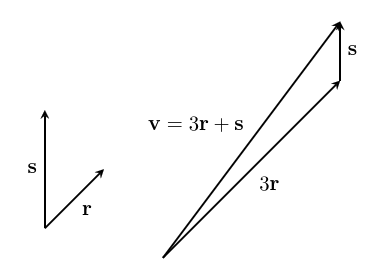
Here are some vectors:
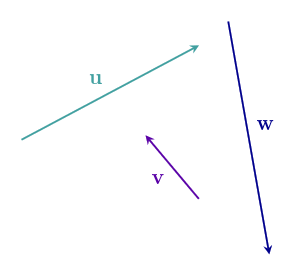
We can use these vectors to make other vectors, by taking different amounts of each one, adding all the parts together:
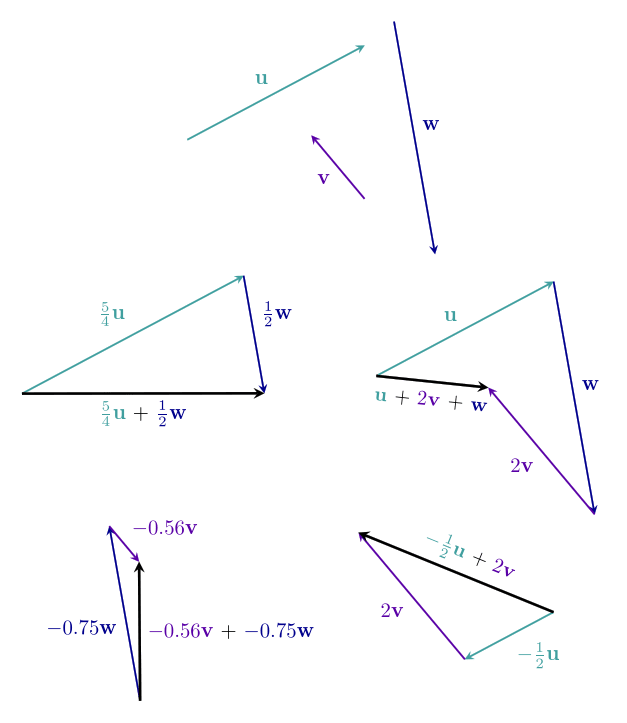
This is called a linear combination.
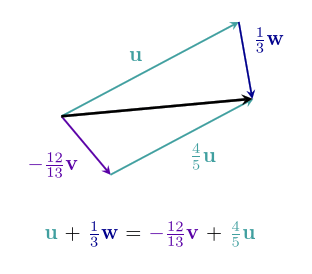
Sometimes, there are different ways to make the same vector from a certain set of ingredient vectors:
Sometimes, there are no ways to make a particular vector. This is easiest to see in three dimensions:
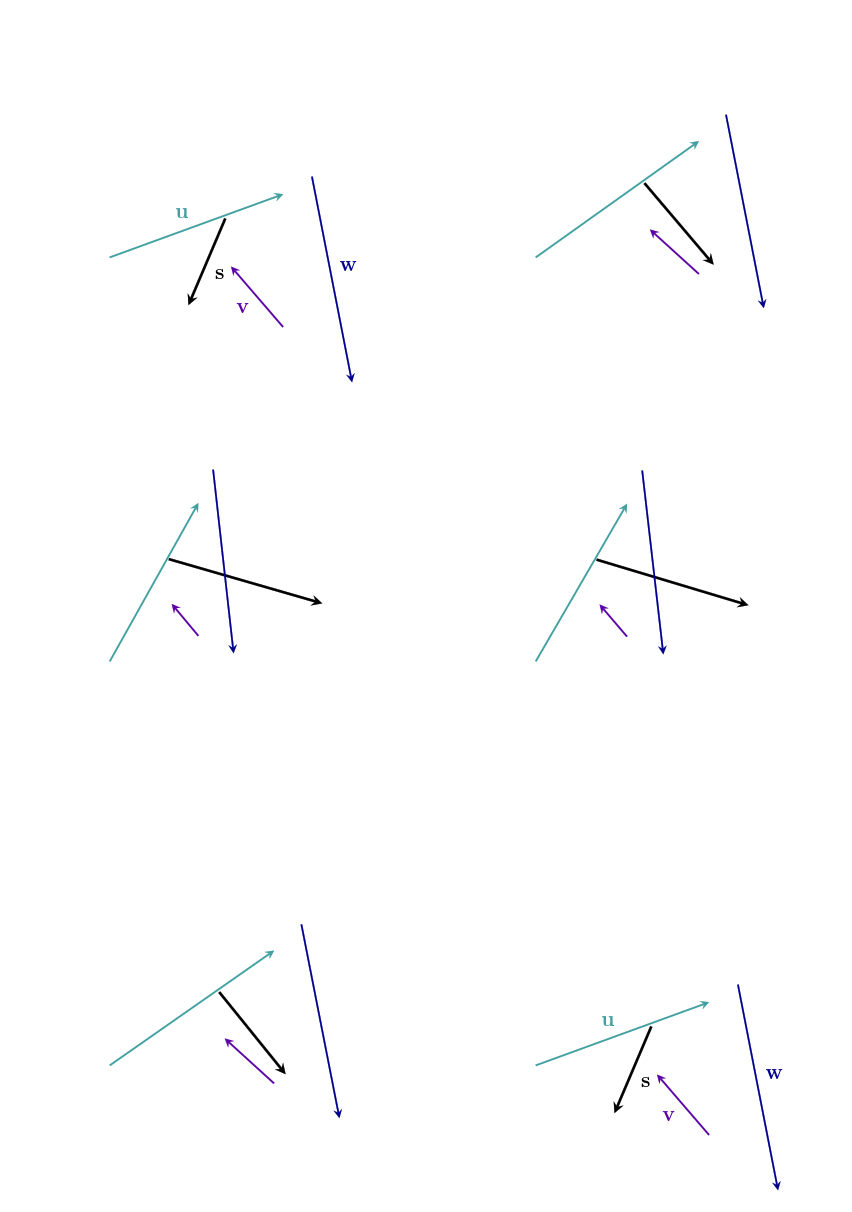
We call the set of all the vectors that are reachable by our set of vectors the span of those vectors.
Basis
How many vectors do we need to span the whole vector space? It depends on the space!
For a flat space, , work:
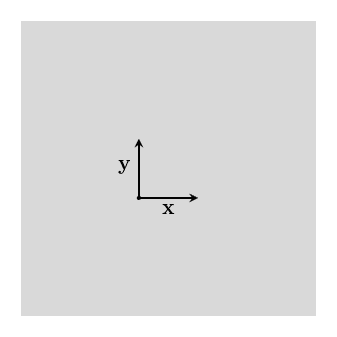
If we remove one or the other, we can't get all the other vectors.
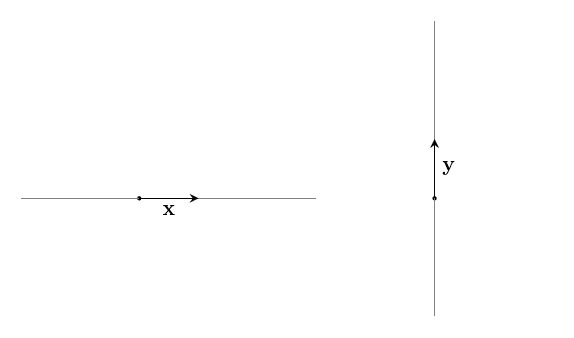
So we might guess that we need two vectors to span a flat space.
To span a space that also has some depth, we can't just use these two vectors though:
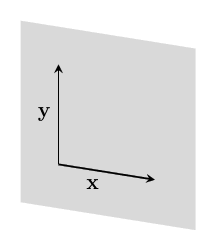
Not even if we just add any other vector in a different direction:
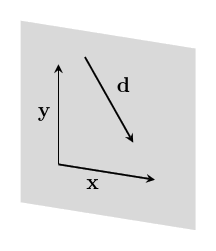
This doesn't work since is a linear combination of and , so adding it doesn't bring us anything new!
We say that linearly dependent on and .
To get the full depth of the space, we need to add a vector that is linearly independent of and , that is, not a linear combination of and .
A linearly independent set of vectors that span the whole space is called a basis for that space.
Dimension
What does a vector space with just one vector in its basis look like?

Linear combinations of are just scaled by different numbers. So the vector space is just any vector in a line containing . A basis with one vector can reach a one-dimensional space.
Now if we have two vectors and in our basis, we can reach any vector within the plane containing both and :
So a basis with two vectors spans a two-dimensional space.
You can probably guess that a basis with three vectors reaches a three-dimensional space.
The dimension of a vector space is the number of vectors in the basis!
This allows us to accurately imagine higher dimensional spaces, even though we cannot visualize them directly. Even though four linearly independent vectors do not exist in physical space, the same mathematical rules can be applied to determine different properties of such a world.
In this way, math allows us to explore all kinds of strange, exotic worlds beyond our own, including vector spaces of any dimension. It also turns out that many of these higher dimensional vector spaces are very useful for real world situations!
Zero dimensions
What is a linear combination of nothing? Just as zero is the amount of things we have if we have nothing, the zero vector is the vector of a linear combination of nothing. So a zero-dimensional vector space is a vector space that has practically nothing - just the zero vector!
Standard basis
It's convenient to work in a standardized basis, with vectors that have convenient properties. In many spaces, there's a standard set of vectors with particular magnitudes and directions that are conventionally used.
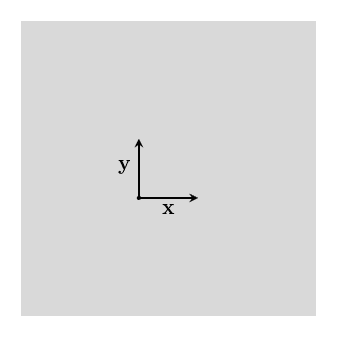
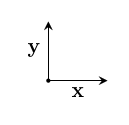
In two dimensional geometric space, the standard basis is , , where and both have magnitude one.
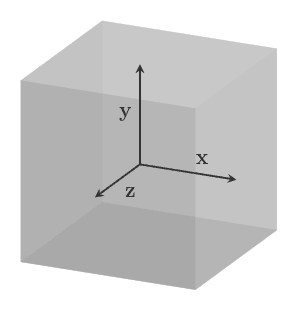
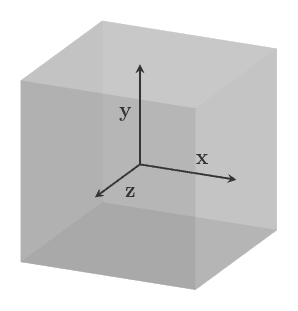
Similarly, in three dimensional geometric space, a basis with vectors , , and , all unit vectors, is commonly used.
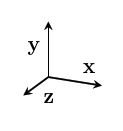
However this one is less standardized, and it is not unusual to see things that use a different convention for three dimensional geometric space.
One property that is very often used is to have a basis where all the basis vectors are normalized to have unit magnitude. This is called a normal basis. [1]
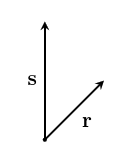
Although using a standardized basis is convenient, it's important to remember that standardized bases are not mathematically fundamental. The math works equally well when using any basis.
Coordinates
if we have a basis, we can describe any vector as a linear combination of basis elements in exactly one way.
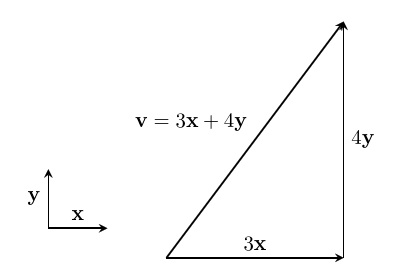
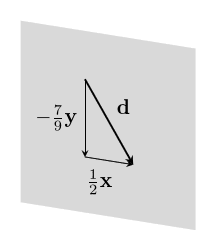
The scaled basis vectors we use to reach our vector are called the components of . In this example, the -component of is -2, and the -component of is -1. We can also refer to this vector by the list of the scalars for each of the components, these are called the coordinates of the vector. So the coordinates of are in this case.
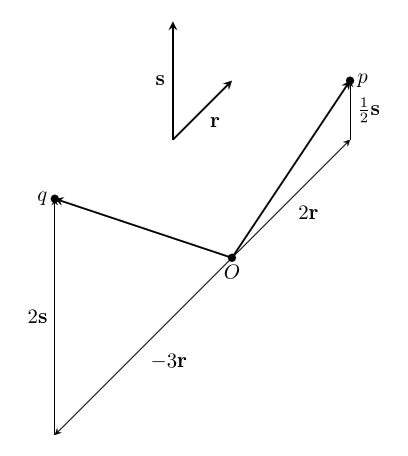
It's important to remember that if we use a different basis, the same vector will have different coordinates:
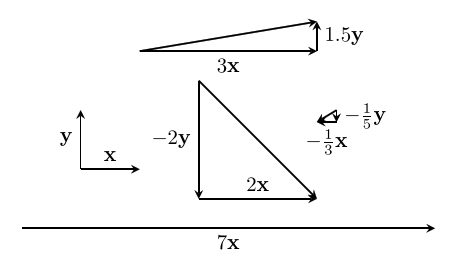
Coordinates give us a handy way to refer to different vectors in the space:
Reference point
We can do a similar thing with points. We choose a particular point as a reference point, called the origin.

We can now describe points by the vector will take us from the origin to that point. And we can describe that vector in terms of the basis vectors, using coordinates!
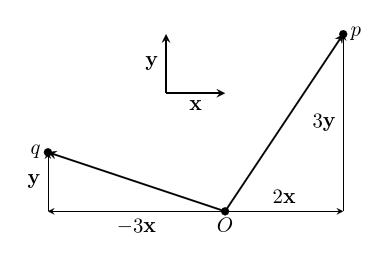
We call these the coordinates of the point. For short, we can write this just as – but it's really important to make sure that we are clear on what basis is being used, and what the origin is. In the basis we used earlier, and with the same origin, can be described as
Next, we will start exploring the things that make geometric vectors geometric, but thinking about how we can compare different vectors to each other.
- ^︎
It's also useful to have a basis where all the vectors are in as different directions as possible. However, this only makes sense in vector spaces with a concept of angle. We'll learn about angle in geometric vector spaces soon. A basis with this property is called an orthogonal basis (Orthogonal is Greek for right angular). A basis that is both orthogonal and normal is called an orthonormal basis.