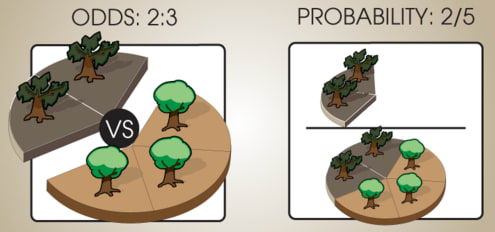
Odds express relative belief: we write "the oddsare a tool for X versus Y are 17:2" when we think that proposition X is 17/2 = 8.5 times as likely as proposition Y.
Odds don't say anything about how likely X or Y is in absolute terms. X might be "it will hail tomorrow" and Y might be "there will be a hurricane tomorrow." In that case, it might be the case that the odds for X versus Y are 17:2, despite the fact that both X and Y are very unlikely. Bayes' rule is an example of an important operation that makes use of expressing relative belief.
Odds can be expressed between many different propositions at once. For example, let Z be the proposition "It will rain tomorrow," the odds for X vs Y vs Z might be (17:2:100). When odds are expressed between only two propositions, they can be expressed using a single ratio. For example, above, the odds ratio between X and Y is 17/2, the odds ratio between X and Z is 17/100, and the odds ratio between Y and Z is 2/100 = 1/50. This asserts that X is 8.5x more likely than Y, and that Z is 50x more likely than Y. When someone says "the odds ratio of sick to healthy is 2/3", they mean that chances. If the odds of sickness vs healtha tree in a forest being sick versus healthy are 2:3.
Formal definition
Given n propositions X1,X2,…Xn, a set of odds between the propositions is a list (x1,x2,…,xn) of non-negative real numbers. Each xi in the set of odds is called a "term." Two sets of odds (x1,x2,…,xn) and (y1,y2,…,yn) 3, this says that there are called "equivalent" if there is an α>0 such that αxi=yi for all i from 1 to n.
When we write a set of odds using colons, like (x1:x2:…:xn), it is understood that the '=' sign denotes this equivalence. Thus, (3:6)=(9:18).
A set of odds with only two terms can also be written as a fraction xy, where it is understood that xy denotes the odds (x:y). These fractions are often called "odds ratios."
Example
Suppose that in some forest, 40% of the trees are rotten and 60% of the trees are healthy. There are then 2 rottensick trees for every 3 healthy trees, so we say that the relative odds of rotten trees to healthy trees is 2 : 3. If we selected a tree at random from this forest, thetrees. (The probability of getting a rotten tree would bebeing sick, in this case, is 2/5, but the odds would be 2 : 3 for rotten vs. healthy trees.5 or 40%.)
Conversion between odds and probabilities
Consider three propositions, X,Y, and Z,