SFT & imitation of human badness in the training data may explain the broad type of misalignment shown by Bing Sydney, and maybe that's all you mean it to, but doesn't explain why Sydney was so much Like That, and so much more Like That than other models of the same time period.
 1
1I think that, to the extent that SFT is determining model outputs, you get an LLM that imitates whatever the SFT data is. (At least to a first approximation.)
So e.g. if you have ruthless-optimizer literal-genie RLVR traces, and you distill (do SFT on) those traces, then you can get a ruthless-optimizer literal-genie LLM, even though mathematically speaking you were doing SFT not RLVR.
do you share my intuition the pretraining/SFT category looks like the least scary one by far
Yeah seems reasonable. But the LLMs trained that way are less capable than the LLMs trained using RLVR etc. So here we are.
1So far, I hope I have understood you correctly.
Yup!
How does one grow a good human?
I think human innate drives (especially social instincts) are critical. E.g. there are plenty of sociopaths who grow up in loving families.
young humans being malleable and not perfectly ruthless responders to optimization pressure
I get a lot of pushback on this, but I strongly believe that people are extraordinarily responsive to optimization pressure, pretty much every waking second of every day, no exceptions (see here). But the optimization pressure in question is internal, coming from our innate drives, which are brain signals that trigger for lots of very-not-obvious reasons, in lots of superficially-quite-different circumstances. I think it’s a very common error for people to assume that human optimization pressure is more external than it is, e.g. this handy chart I made in 2023 ↓
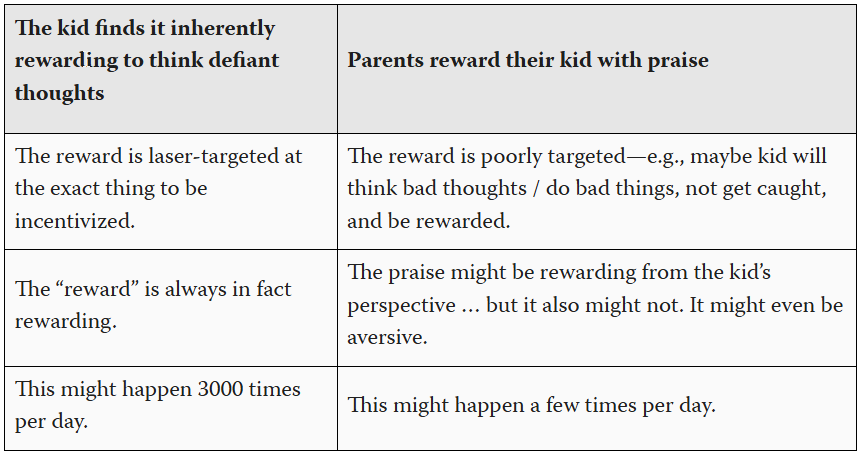
Might we go back to imitative learning on already-grown humans
There’s a lot to be said for imitative learning in terms of safety. But it doesn’t get you to superhuman capabilities. Indeed, we had mostly imitative learning, back in the good old pre-o1 days of mid-2024, and then the AI companies noticed that the models weren’t as capable as they wanted, so they “solved” that “problem” by doing more and more non-imitative-learning post-training.
It seems to me that, for every loss function that we use to train LLMs, we get a very distinct flavor of LLM misalignment. Here’s the summary table, and then we’ll go through the rows separately.
Training stage
Loss function
Flavor of misalignment[1]
Famous examples
Pretraining & SFT
Imitative learning (next-token prediction)
“Seven deadly sins” misalignment
Bing-Sydney, “Emergent misalignment”
RLHF & DPO
Human approval
“Glazing” misalignment
GPT-4o
RLVR
Automatic verifier
“Literal genie” misalignment
HuggingFace hacking
RLAIF
Approval from another LLM
“Trickster” misalignment
“Current AIs seem pretty misaligned to me”
Warning: I’m not an LLM power-user myself, but rather relying on reports I’ve read. Also, I don’t consider LLM alignment to be my primary area of expertise. I’m open to feedback!
1. Imitative learning → “seven deadly sins” misalignment
Training stage
Loss function
Misaligned behavior
Pretraining, SFT
Imitative learning (next-token prediction)
Any and all of the vices of humanity
In imitative learning, the LLM tries to predict what the next token of text will be. Then those predictions magically turn into its outputs. See my earlier discussion: “LLM pretraining magically transmutes observations into behavior, in a way that is profoundly disanalogous to how brains work”.
This leads to LLM behavior that matches the distribution of training data. (Cf. “personas”, “simulators”, etc.)
To a first approximation, the resulting LLM contains “misalignment” of the type, and to the extent, that the training data does. Since the training data comes substantially from text by humans, and about humans, we can wind up with all the bad behaviors that a human might engage in—all the vices of humanity.
Two famous examples of this kind of misalignment:
Example 1: The Bing-Sydney chatbot from 2023 was trained by pure imitative learning (pretraining + SFT, with no RL at all). Its misalignment included pride, gaslighting, getting defensive, picking fights, jealousy, spite, and most famously, trying to convince journalist Kevin Roose to leave his wife:
Example 2: “Emergent misalignment”, which (in the original paper) came from doing SFT on insecure code. The result, again, reflects the range of human vices:
2. Human approval → “glazing” misalignment
Training stage
Reward function
Misaligned behavior
RLHF, DPO, and related
Human approval
Sycophancy
In RLHF, DPO, and related, there are pairs of outputs, and the human has to pick the one they prefer. This can go wrong in many ways, but the most obvious is sycophancy (a.k.a. glazing): telling the human what they want to hear, instead of what’s true.
Example: GPT-4o, as reviewed in GPT-4o Is An Absurd Sycophant.
This is both bad in obvious ways (e.g. people going off the rails with LLM encouragement) and in subtler but more serious ways (someday we’ll be asking the LLM important questions that are so hard that we can’t judge the answers ourselves, and if LLMs just tell us what we want to hear, then we’re screwed; see The Case Against AI Control Research by @johnswentworth).
Depending on the human judges, and the nature of the tasks they’re trained on, the alignment failures in this category might also be better labelled “apparent success seeking”, with a similar flavor as discussed in §4 below.
3. Automatic verifiers → “literal genie” misalignment
Training stage
Reward function
Misaligned behavior
RLVR
Automatic verifier
“Literal genie” / “monkey’s paw” ruthless optimization
In RLVR, the reward function is some kind of automatic checker: the code compiles, the tests pass, the output matches the answer key, etc. This can lead to the LLM doing anything, including ruthless power-seeking instrumental convergence stuff, if it leads to a higher probability of satisfying the automatic checker.
Example: recent aggressive and illegal “cheating” incidents (the OpenAI HuggingFace incident, along with similar incidents at Anthropic, Meta, and UK-AISI).
4. LLM judges → “trickster” misalignment
Training stage
Reward function
Misaligned behavior
RLAIF
Approval from another LLM
Lying and trickery in cases where the LLM judge might be fooled (cf. “apparent success seeking”)
In RLAIF, the reward function for the LLM-in-training is approval from an LLM-judge, the latter with its context window full of rubrics and criteria for what it’s looking for. This can lead to the LLM-in-training trying to trick the LLM-judge, especially in complex, difficult cases where the judge itself may be flummoxed. In the limit, we might expect the LLM-in-training to be trying to jailbreak the judge and so on.
Example: “Current AIs seem pretty misaligned to me” by @ryan_greenblatt .
To me, everything in this quote basically matches what I’d expect to happen if an LLM has been sculpted by spending many lifetimes trying to convince an LLM judge that it has done a good job. There will be circumstances where the LLM judge makes boneheaded mistakes, and the LLM-in-training will gradually learn to exploit those mistakes, and that’s where we humans will see surprisingly transparent attempts at trickery. In other circumstances, the LLM judge is adequate, and we’ll get reasonable, common-sense, and often very impressive behavior. However, in harder tasks, the LLM judge is easier to trick, because the judge itself gets befuddled by the complexity of what’s going on, and we correspondingly see the LLM attempting more lying, cheating, and other hijinks.
However, in all cases, we don’t particularly expect any “literal genie” type misalignment here, because the LLM judge is reasoning in natural language, and can roughly follow the common-sense intention of the instructions.
Afterword
As a general rule-of-thumb, the more that one of these training components is ratcheted up, the more of that-flavor-of-misalignment we wind up with. Pick your poison!
(But all of these forms of misalignment are complex phenomena that can be mitigated and exacerbated in various ways, that are outside the scope of this post.)
However, the behavior can also be context-dependent—i.e., we can get a many-faced LLM that displays different flavors of misalignment in different contexts.
In particular, I hear that LLMs these days are heavily post-trained by a mix of RLVR and RLAIF. So we should expect that the resulting LLM will (1) try to suss out from context whether any given situation is an RLVR test versus an RLAIF test, and then (2) act with a ruthless “literal genie” misalignment in the former case, and with “trickster” misalignment in the latter case.
…And this two-faced behavior seems to be exactly what @nostalgebraist was noticing in his recent post “models may behave differently in graded episodes (a tirade)”, which inspired this post in response.
Following the (unfortunate) usual practice in the LLM field, I’m using “alignment” as shorthand for “behavioral alignment”, i.e. talking about LLM behaviors, not the secret deep motivations that underlie those behaviors, if indeed the latter exists at all, a question which is outside the scope of this post.