This is a special post for quick takes by Lukas Finnveden. Only they can create top-level comments. Comments here also appear on the Quick Takes page and All Posts page.
Comment Permalink
There's some recent discourse about a chart that shows AECI points declining per $ spend, despite recent acceleration of AECI per year.
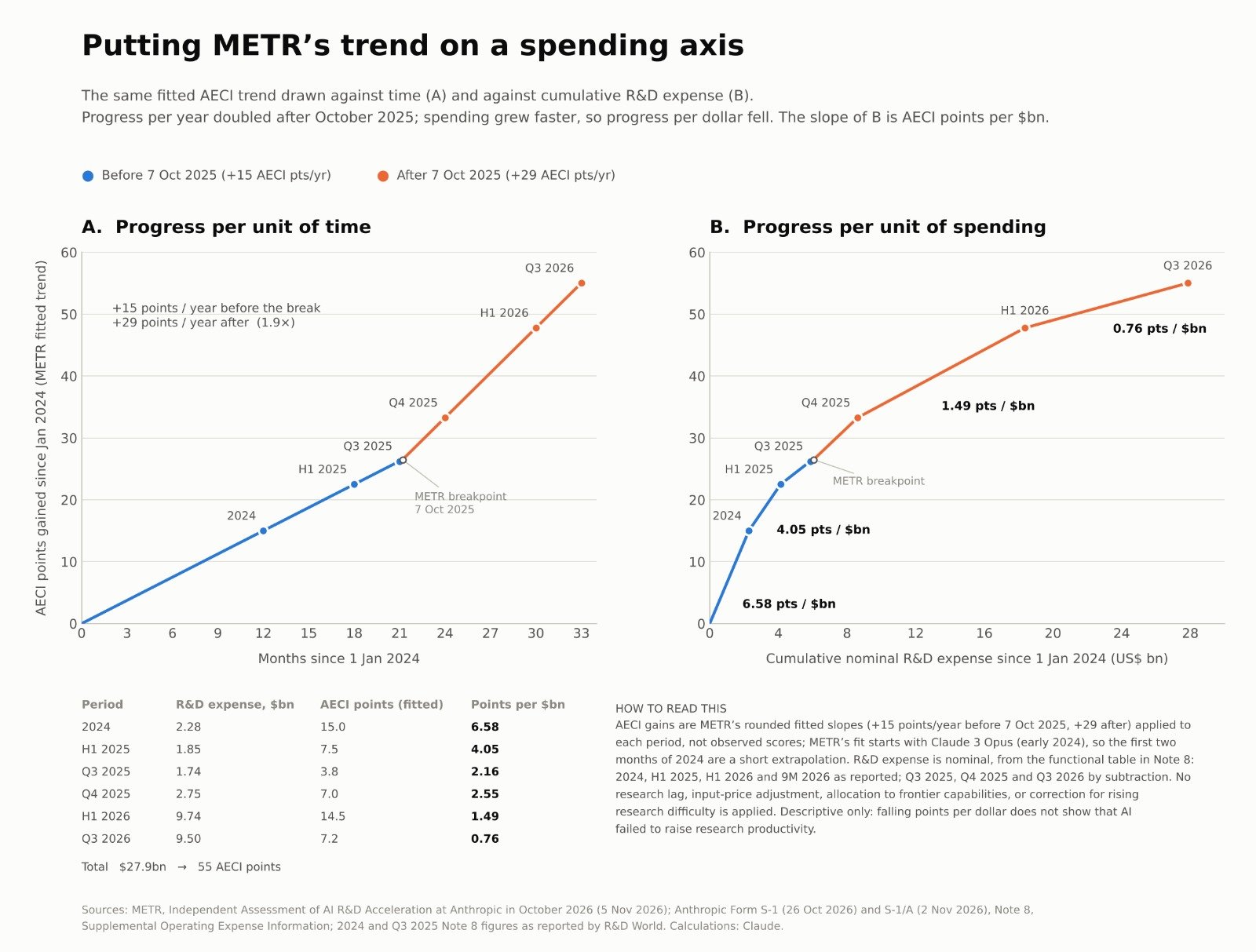
As other people have commented (e.g.) it is broadly acknowledged that you need exponentially growing inputs in order to sustain linear increases in AECI. Nevertheless, once AI R&D is fully automated, linear increases in AECI will likely give exponential improvements in inputs, and depending on the parameters, this might suffice for a software-only takeoff. (Note that linear increases in AECI points has historically corresponded to exponential growth in eg time horizons.)
But the above chart only shows exogenous inputs on the x-axis. So once you are in a takeoff where the pace of progress accelerates rather than decelerates (even with constant exogenous inputs), a chart like this should show that AECI/$ is increasing rather than decreasing. Because measures of exogenous inputs don't take into account the gains you're getting from RSI, which is doing most of the work at that point.
In fact, according to simple economic models, if we see AECI points per exogenous inputs increase rather than decrease on a chart like the above, then I think that's sufficient to establish that a software-only takeoff is possible and has begun.[1]
But then: What are we supposed to make of the chart above? We see an increase in AECI/$ in late 2025, but then a continued decrease through 2026? What does it mean?
I think this is confounded by how spending is an imperfect measure of the non-AI contributions to AI R&D progress. (E.g. it's unclear what time-lag to use for spending–>progress; and there's going to be some random variation in how cost-effectively companies can spend their $s on inputs to AI progress at different points in time.)
Most importantly: The above chart isn't taking into account METR's estimate that the excess growth due to AI was increasing over the past year, while the share of excess growth due to non-AI factors was declining:
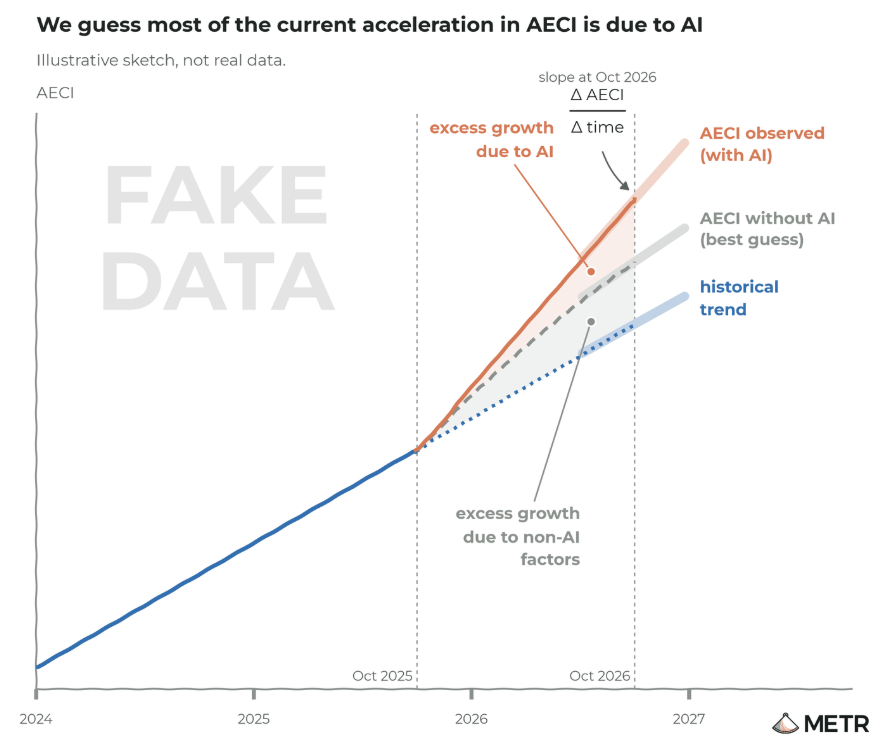
Since the precise data is fake (and any real best-guess numbers are redacted), we can't fit exact numbers to it, but let's transform this data to get a sense of the qualitative implications. We will pretend that:
- Non-AI inputs were growing at 3x per year historically.
- Starting Oct 2025, non-AI inputs rose above that trend by just enough to produce METR's grey line.
Under these assumptions, here's the plot that Claude gets me for overall AECI-per-cumulative-exogenous-input, using the same format as the top graph.[2] ("AECI points against units of cumulative non-AI input.")
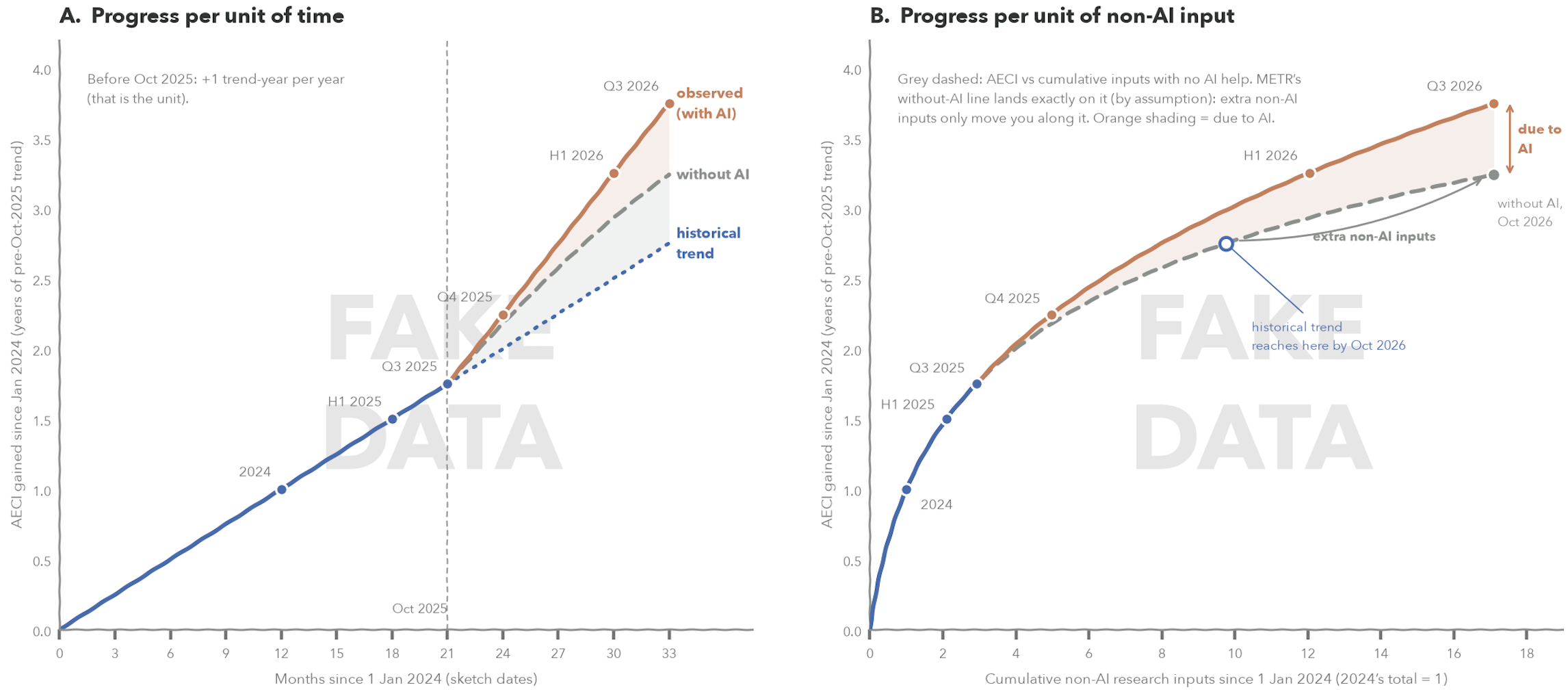
As you can see, on this plot, the orange line is bending from a decelerating-over-time trajectory towards a trajectory that looks like it's decelerating more slowly, or perhaps growing approximately linearly, or perhaps starting to accelerate. Can't tell since the data is fake.
If the trajectory was truly approximately linear, now, then that would imply that AECI-point/$ is approximately constant rather than declining. If AI companies kept scaling up their exogenous inputs exponentially then we would switch from gaining a constant number of AECI points per year to gaining an exponentially increasing number of AECI points per year. (Implying doubly exponential progress on e.g. time horizon.)
More likely, in my opinion, is that we don't stay in the knife-edge linear regime but instead that the curve keeps bending until progress per exogenous input is increasing. At that point, a software-only singularity is possible, and even with a constant spend per year we would be accelerating hyperbolically towards arbitrarily fast growth. (Until some limits set in.)
- ^
TBC, it would in reality most likely be further accelerated by continued exponential increases in exogenous inputs, rather than actually being a software-"only" takeoff. The meaning of "software-only" is just that it could happen on a fixed basis of hardware.
- ^
To get this, Claude further assumes that research effort = (AI's speed-up factor) × (non-AI inputs), and that each doubling of cumulative research effort adds a fixed amount of AECI points.
- ^
AECI points per $ could technically go up due to reduced compute prices or cheaper labor, so "real inputs" is supposed to be something that's closer to the pure input than that.