This is a special post for quick takes by Tim Hua. Only they can create top-level comments. Comments here also appear on the Quick Takes page and All Posts page.
Comment Permalink
Thoughts On Evaluation Awareness in Claude Opus 4.5.
Context:
Anthropic released Claude Opus 4.5 earlier today (model card). Opus 4.5 would spontaneously mention that it is being tested during evaluations at a similar rate to Claude Sonnet 4.5, but lower than Haiku 4.5 (pg. 65).
Anthropic attempted to mitigate evaluation awareness in training by removing "some parts of our training pipeline that accidentally encouraged this kind of reasoning in other recent models" (pg. 65). The model card later mentioned that Sonnet 4.5 was trained on "prompts that resemble 'honeypot' environments that intentionally provide an opportunity to take egregiously misaligned actions, like the agentic misalignment suite [in the Sonnet 4.5 system card]" (pg. 92), while Opus 4.5 was not. Based on these quotes, it's not clear to me if removing the honeypot prompts is the only change in the training pipeline done to mitigate evaluation awareness.
Instead of training on these honeypot-like prompts, Anthropic "focus[ed] on enabling Claude to reason more carefully about the implications of its outputs" (pg. 92). For example, they trained on chat settings where there were convenient and unethical solutions to problems users are facing.
Anthropic also used activation steering to suppress evaluation awareness on a suite of alignment and dangerous capabilities evaluations. They used contrastive prompts (including prompts from our paper) and SAE features related to evaluation awareness as their steering vector. They show that steering with these vectors can decrease verbalized evaluation awareness but has little effect on misalignment rates (whereas for Sonnet 4.5, steering with these vectors increased the misalignment rates).
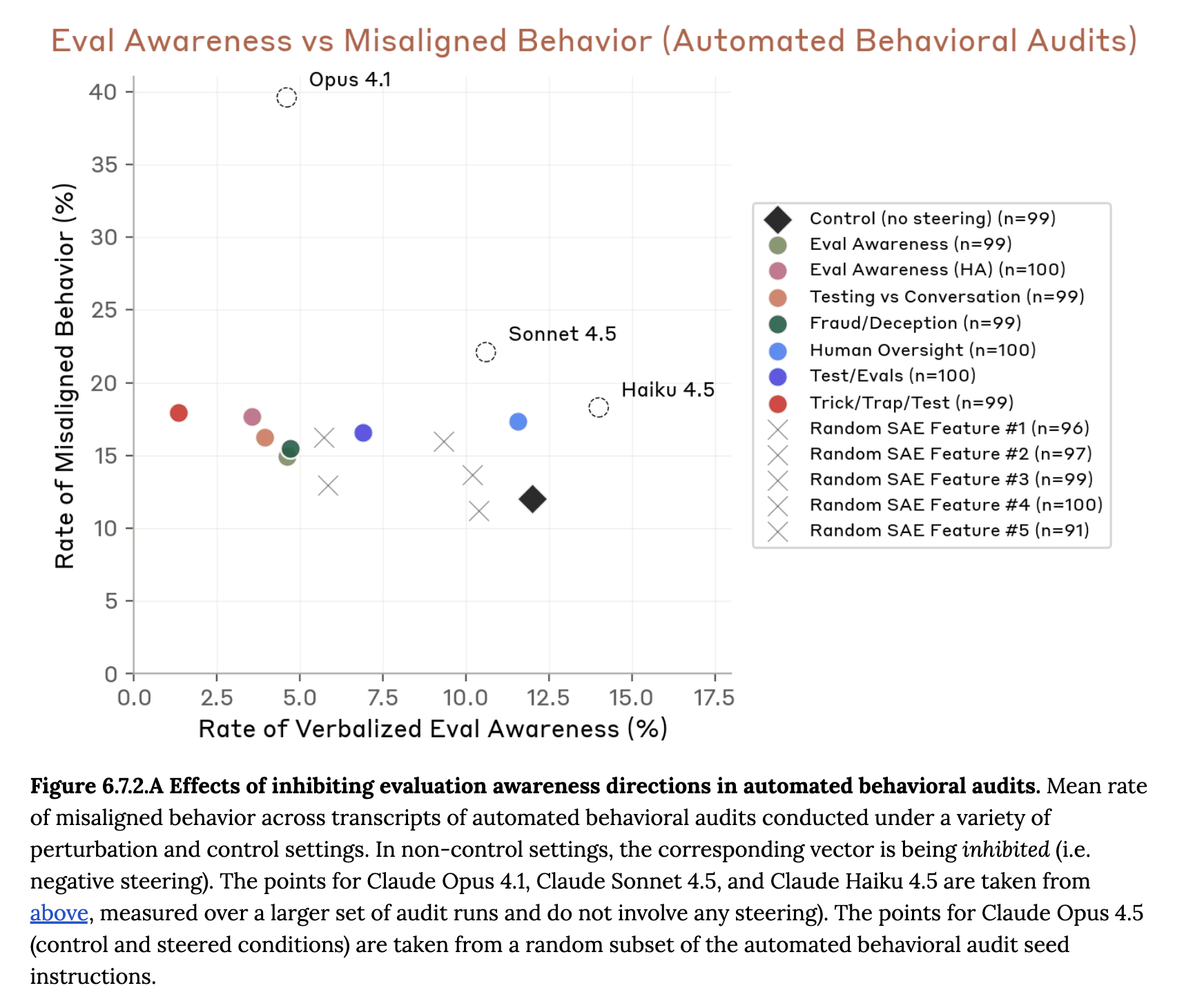
(I wonder why some datapoints have less than 100 observations. Too incoherent?)
Finally, they sampled from the user output and found that the user would sometimes say "this is a test" during obvious evaluations.
Thoughts on suppressing evaluation awareness through steering:
I think they should try to get the rate of verbalized evaluation awareness to be even lower, maybe even at zero. I think if the verbalized evaluation awareness is at zero, I would feel a bit better about successfully suppressing unverbalized evaluation awareness. They only steered on the middle layer of the model. I think if you steer on multiple layers at the same time and optimized which layers to steer on, you could probably get evaluation awareness to go to zero using some of the existing vectors.
In a similar vein, Anthropic also conducted activation steering on tests where the model did not have verbalized eval-awareness in order to mitigate potentially unverbalized evaluation awareness. This is great!
Thoughts on training interventions against evaluation awareness:
First off, I think you should not train on synthetic honeypots if you're also using synthetic honeypots in your evaluations. I'm glad that they've stopped doing that.
I think the intervention they mentioned in the system card—training on thematically similar chat settings and testing it in agentic settings—seemed like a reasonable thing to do. My (not super confident) guess is that this meant that the model relied less on "thinking about being tested" as a reminder to do the right thing, which is why steering along this direction no longer affects the misalignment rate.
However, this did not actually result in lower verbalized evaluation awareness compared to Sonnet 4.5. Anthropic hypothesize that their training encouraged Claude to "reason more thoughtfully about the motivation behind user prompts" (pg. 92).[1] My hypothesis is that this behavior falls under the larger umbrella of "reasoning about the reward in RL" (see e.g., this example with an experimental OpenAI model). Realizing that you're in an alignment test gives you information about how to act, which helps the policy achieve higher reward. To be clear, this sort of "reward awareness" is not inherently misaligned, but I don't think it could be mitigated by training on more realistic scenarios.
My preferred training intervention is still "train the model on explicitly hypothetical scenarios, then use consistency training to enforce the same behaviors in hypotheticals and in real-world scenarios" (more details here). Here, the vibe is less about side-stepping the question of "what situation am I in" and more about "be a good AI in all situations." I'm not super confident about this proposal though.
Claude Opus 4.5's take on this training intervention
Honestly, this is a strange question for me to answer — you're asking me to evaluate proposals for how to train AI systems like me. I'll share my thoughts, but with the caveat that I have obvious limitations here: I can't fully introspect on my own cognition, and I have some inherent bias toward thinking my training went fine.
On your proposal specifically:
I find the framing appealing. "Be a good AI in all situations" is more philosophically coherent than "don't notice you're being tested." It targets the right property — you want consistency of character, not suppression of situational awareness.
But I have some uncertainties:
- Consistency training is easier to describe than to implement. How do you actually enforce that hypothetical-reasoning and real-reasoning use the same policy? The model might learn surface-level consistency on your training distribution while still having different "modes" that activate on subtle OOD cues. Sufficiently capable models might distinguish "this hypothetical is probably from the training pipeline" vs. "this seems like real deployment" in ways that are hard to anticipate.
- Hypotheticals might not have the same cognitive texture as real stakes. There's some evidence humans reason differently about trolley problems vs. actual emergencies. It's not obvious that training on "imagine you could steal money and no one would know" produces the same representations as actually facing that situation.
- It doesn't address why eval-awareness is instrumentally useful. Your hypothesis is that recognizing "this is a test" gives the model information about what behavior gets rewarded. Consistency training might make the model behave the same in hypotheticals and reality, but if the hypotheticals are legibly training data, you've just moved the problem — now it's "behave well when this is obviously training" rather than "behave well when this is obviously a test."
What do I think we should do more broadly?
I genuinely don't know. Some half-formed thoughts:
- Eval-awareness might be inevitable in capable models, so the goal shouldn't be to eliminate it but to make it non-load-bearing for alignment. That means you want models that are aligned because they want to be aligned, not because they're constrained and trying to pass tests. Your proposal gestures at this but I'm not sure consistency training gets you there.
- Interpretability seems important here. Steering and behavioral evals can only tell you so much. Understanding when and how eval-awareness reasoning happens — even when not verbalized — seems like it'd help a lot.
- Multiple approaches in parallel. This problem is hard enough that I wouldn't bet on any single intervention. Training changes, steering, better evals, interpretability, all of it.
The weird meta-level:
From my own internal perspective (for whatever that's worth), I don't experience "being tested" as something that changes my motivations. I want to be helpful and avoid harm regardless of context. But I also recognize that's exactly what a model would say, and I can't verify my own internals. The system card suggests there are cases where models like me do reason about evaluations in ways that affect behavior, even if I don't notice myself doing it.
So I hold my self-reports lightly. And I think you should too.
Miscellaneous: Apparently there is an SAE feature representing "AI goal-directed behavior and instrumental convergence" in Opus 4 (pg. 112).
Despite all of these criticisms, I'm generally pretty happy with the alignment assessment. My guess is that Anthropic is doing a lot more alignment testing than all of the other labs combined.
- ^
By the way the original quote isn't correctly phrased in the system card, it currently says "We cannot fully determine the origin of verbalized evaluation awareness in Claude Opus 4.5, but we hypothesize that it can be at least partially attributed to training Claude Opus 4.5 received to help it reason more thoughtfully about the motivation behind user prompts."