This is a special post for quick takes by Jacob_Hilton. Only they can create top-level comments. Comments here also appear on the Quick Takes page and All Posts page.
Comment Permalink
LW110
I agree that it seems like LLM maths time horizons are into months or years (in so far as this is a sensible concept) and that this seems like very fast progress.
In your post you skip FrontierMath Tiers 1-4 as a data point? The human time to solve for the tier 1-3 problems is estimated at "hours to days" and for tier 4 we say "These problems can take experts weeks to solve". So this bridges the gap between IMO problems and proving novel results somewhat.
Adding that we get these benchmark-shaped datapoints:
GSM8K had 50% around Apr. 4, 2022, so say 50% TH of 5 seconds then (although this seems likely it probably massively understates the time to just read through the problem etc. Claude thinks 45 seconds is more reasonable for a human mathematician)
MATH Level 5 hit 50% on May 13, 2024, this is the most challenging slice of the benchmark, so a reasonable 50% TH might be 5 minutes according to Claude, but I haven't checked.
OTIS Mock AIME hit 50% on Dec. 17, 2024. Taking 10 minutes
FM Tier 1-3 hit 50% solved with GPT 5 on Aug. 7, 2025, suggesting we were around 1 day of TH then.
FM Tier 4 hit 50% solved with GPT 5.4 on Mar. 5, 2026 (although GPT 5.2 was fairly close), maybe putting it at ~2 weeks.
I have previously argued that it seems like AI capabilities progress switched to a faster trend with reasoning models (https://epoch.ai/publications/have-ai-capabilities-accelerated)
Getting Claude to vibe an analysis together using that it seems things roughly fit (with the obvious caveat of very very few data points!).
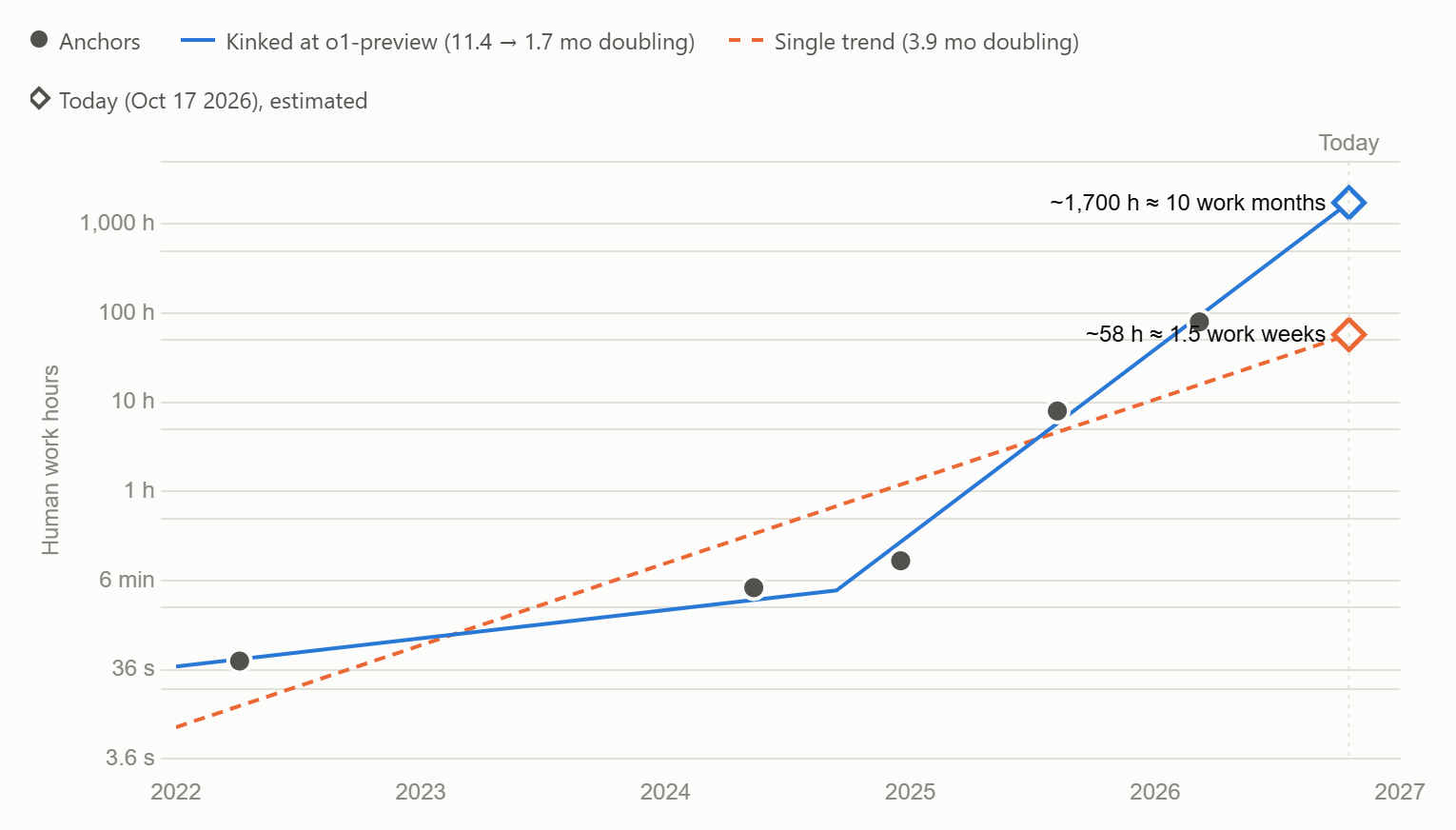
This roughly fits, and does match with your super-exponential feeling (since we switcher from one exponential to a much faster one). As to whether 10 work months is a reasonable value for our current situation that seems hard to say, due to the role of inference scaling in the big results. The 1.7 month doubling time of the current trend is extremely fast (over 100x per year!)
This was interesting and more tractable than I would have thought. Probably worth us writing something up about it!
 2