Here's a recent attempt of mine at a distillation of a fragment of this plan, copied over from a discussion elsewhere:
goal: make there be a logical statement such that a proof of that statement solves the strawberries-on-a-plate problem (or w/e).
summary of plan:
background context: there's some fancy tools with very nice mathematical properties for combining probabilistic reasoning and worst-case reasoning.
key hope: these tools will let us interpret this "manual multi-level world-model" in a way that keeps enough of the probabilistic nature for tractable policies to exist, and enough adversarial nature for this constraint to be pretty tight.
in more concrete terms: for any given UFAI, somewhere in the convex hull of all the interpretations of the manual multi-level world model, there's a model that sees (in its high-level) the shady shit that the UFAI was hoping to slip past us. So such "shady" policies fail in the worst-case, and fail to satisfy the theorem. But also enough of the probabilistic nature is retained that your policies don't need to handle the literal worst-cases of thermodynamic heat, and so there are some "reasonable" policies that could satisfy the theorem.
capabilities requirements: the humans need to be able to construct the world model; something untrusted and quite capable needs to search for proofs of the theorem; the policy extracted from said theorem is then probably an AGI with high capabilities but you've (putatively) proven that all it does is put strawberries on a plate and shut down so \shrug :crossed_fingers: hopefully that proof bound to reality.
(note: I'm simply attempting to regurgitate the idea here; not defend it. obvious difficulties are obvious, like "the task of finding such a policy is essentially the task of building and aligning an AGI" and "something that can find that policy is putting adversarial pressure on your theorem". even if proving the theorem requires finding a sufficiently-corrigible AGI, it would still be rad to have a logical statement of this form (and perhaps there's even some use to it if it winds up not quite rated for withstanding superintelligent adversaries?).)
Anticipating an obvious question: yes, I observed to Davidad that the part where we imagine convex sets of distributions that contain enough of the probabilistic nature to admit tractable policies and enough of the worst-case nature to prevent UFAI funny business is where a bunch of the work is being done, and that if it works then there should be a much smaller example of it working, and probably some minimal toy example where it's easy to see that the only policies that satisfy the analogous theorem are doing some new breed of optimization, that is neither meliorization nor satisfaction and that is somehow more mild. And (either I'm under the illusion of transparency or) Davidad agreed that this should be possible, and claims it is on his list of things to demonstrate.
(note: this is the fragment of Davidad's plan that I was able to distill out into something that made sense to me; i suspect he thinks of this as just one piece among many. I welcome corrections :-))
Edited to add (2024-03): This early draft is largely outdated by my ARIA programme thesis, Safeguarded AI. I, davidad, am no longer using "OAA" as a proper noun, although I still consider Safeguarded AI to be an open agency architecture.
Note: This is an early draft outlining an alignment paradigm that I think might be extremely important; however, the quality bar for this write-up is "this is probably worth the reader's time" rather than "this is as clear, compelling, and comprehensive as I can make it." If you're interested, and especially if there's anything you want to understand better, please get in touch with me, e.g. via DM here.
In the Neorealist Success Model, I asked:
This post is a first pass at communicating my current answer.
Bird's-eye view
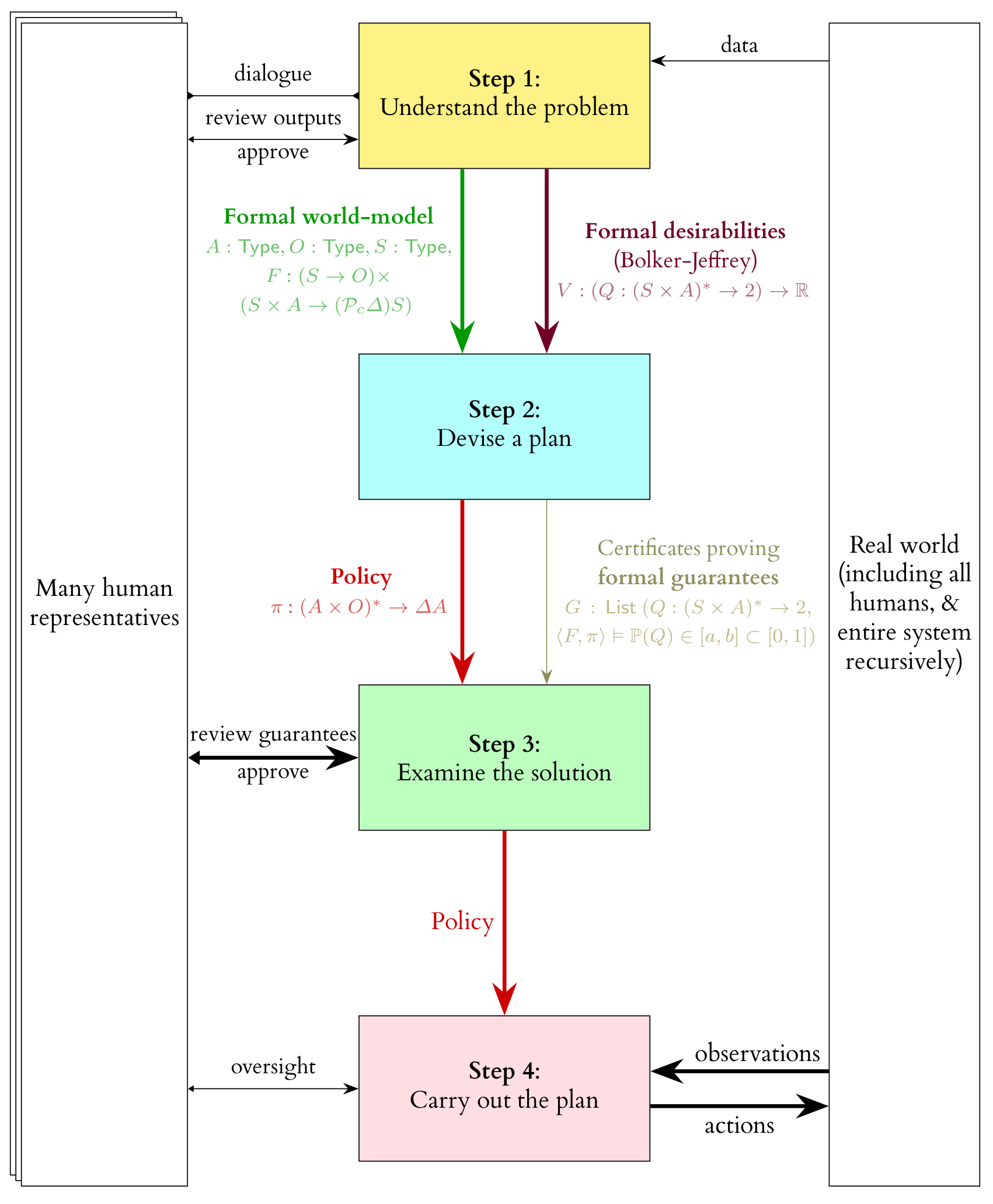
At the top level, it centres on a separation between
We see such a separation in, for example, MuZero, which can probably still beat GPT-4 at Go—the most effective capabilities do not always emerge from a fully black-box, end-to-end, generic pre-trained policy.
Hypotheses
- Scientific Sufficiency Hypothesis: It's feasible to train a purely descriptive/predictive infra-Bayesian[1] world-model that specifies enough critical dynamics accurately enough to end the acute risk period, such that this world-model is also fully understood by a collection of humans (in the sense of "understood" that existing human science is).
- MuZero does not train its world-model for any form of interpretability, so this hypothesis is more speculative.
- However, I find Scientific Sufficiency much more plausible than the tractability of eliciting latent knowledge from an end-to-end policy.
- It's worth noting there is quite a bit of overlap in relevant research directions, e.g.
- pinpointing gaps between the current human-intelligible ontology and the machine-learned ontology, and
- investigating natural abstractions theoretically and empirically.
- Deontic Sufficiency Hypothesis: There exists a human-understandable set of features of finite trajectories in such a world-model, taking values in (−∞,0], such that we can be reasonably confident that all these features being near 0 implies high probability of existential safety, and such that saturating them at 0 is feasible[2] with high probability, using scientifically-accessible technologies.
- I am optimistic about this largely because of recent progress toward formalizing a natural abstraction of boundaries by Critch and Garrabrant. I find it quite plausible that there is some natural abstraction property Q of world-model trajectories that lies somewhere strictly within the vast moral gulf of
All Principles That Human CEV Would Endorse⇒Q⇒Don't Kill EveryoneIf those hypotheses are true, I think this is a plan that would work. I also think they are all quite plausible (especially relative to the assumptions that underly other long-term AI safety hopes)—and that if any one of them fails, they would fail in a way that is detectable before deployment, making an attempt to execute the plan into a flop rather than a catastrophe.
Fine-grained decomposition
This is one possible way of unpacking the four high-level components of an open agency architecture into somewhat smaller chunks. The more detailed things get, the less confident I currently am that such assemblages are necessarily the best way to do things, but the process of fleshing things out in increasingly concrete detail at all has increased my confidence that the overall proposed shape of the system is viable.
Here's a brief walkthrough of the fine-grained decomposition:
At this point I defer further discussion to the comment section, which I will pre-emptively populate with a handful of FAQ-style questions and answers.
Here I mostly mean to refer to the concept of credal sets: a conservative extension of Bayesian probability theory which incorporates the virtues of interval arithmetic: representing uncertainty with ranges, generalized to closed convex regions (of higher-dimensional or infinite-dimensional spaces). Variants of this theory have been rediscovered many times (by Choquet, Dempster & Shafer, Williams, Kosoy & Appel, etc.) under various names ("imprecise probability", "robust Bayes", "crisp infradistributions," etc.), each of which has some idiosyncratic features. In the past few years it has become very clear that convex subsets of probability distributions are the canonical monad for composing non-deterministic and probabilistic choice, i.e. Knightian uncertainty and Bayesian risk. Category theory has been used to purify the essential concepts there from the contradictory idiosyncratic features introduced by different discoverers—and to connect them (via coalgebra) to existing ideas and algorithms in model-checking. Incidentally, convex sets of probability distributions are also the central concept in the 2013 positive result on probabilistic reflective consistency by Christiano, Yudkowsky, Herreshoff and Barasz.
PcΔ, seen in my type signature for formal world-model, is the notation for this monad (the monad of "crisp infradistributions" or "credal sets" or etc.), whereas Δ is a monad of ordinary probability distributions.
Infra-Bayesian physicalism goes much farther than the decision theory of credal sets, in order to account for embedded agency via naturalized induction, and casts all desirabilities in the form of irreducibly valuable computations. I think something in this direction is philosophically promising, and likely on the critical path to ultimate ambitious alignment solutions in the style of CEV or moral realism. But in the context of building a stop-gap transformative AI that just forestalls catastrophic risk while more of that philosophy is worked out, I think policies based on infra-Bayesian physicalism would fail to satisfy conservative safety properties due to unscoped consequentialism and situated awareness. It's also probably computationally harder to do this properly rather than just specifying a Cartesian boundary and associated bridge rules.
This is a simplification; for an initial fixed time-period post-deployment in which the agent is building planetary-scale infrastructure, only the agent's own actions' counterfactual impact on the features would be scored.
Actual tampering with physical sensors is already ruled out by model-checking with respect to the entire formal world-model, which is also the sole source of information for the central model-based RL optimizer.