This is a special post for quick takes by Thomas Larsen. Only they can create top-level comments. Comments here also appear on the Quick Takes page and All Posts page.
Comment Permalink
Hypothesis: alignment-related properties of an ML model will be mostly determined by the part(s) of training that were most responsible for capabilities.
If you take a very smart AI model with arbitrary goals/values and train it to output any particular sequence of tokens using SFT, it'll almost certainly work. So can we align an arbitrary model by training them to say "I'm a nice chatbot, I wouldn't cause any existential risk, ... "? Seems like obviously not, because the model will just learn the domain specific / shallow property of outputting those particular tokens in that particular situation.
On the other hand, if you train an AI model from the ground up with a hypothetical "perfect reward function" that always gives correct ratings to the behaviour of the AI, (and you trained on a distribution of tasks similar to the one you are deploying it on) then I would guess that this AI, at least until around the human range, will behaviorally basically act according to the reward function.
A related intuition pump here for the difference is the effect of training someone to say "I care about X" by punishing them until they say X consistently, vs raising them consistently with a large value set / ideology over time. For example, students are sometimes forced to write "I won't do X" or "I will do Y" 100 times, and usually this doesn't work at all. Similarly, randomly taking a single ethics class during high school usually doesn't cause people to enduringly act according to their stated favorite moral theory. However, raising your child Catholic, taking them to Catholic school, taking them to church, taking them to Sunday school, constantly talking to them about the importance of Catholic morality is in practice fairly likely to make them a pretty robust Catholic.
There are maybe two factors being conflated above: (1) the fraction of training / upraising focused on goal X, and (2) the extent to which goal X was getting the capabilities. The reason why I think (2) is a more important / better explanation than (1) is because probably the heuristics that are actually driving the long horizon goal directed behaviors of the model are going to be whatever parts of the models will arise from the long horizon goal directed capabilities training.
Regardless, there's some sort of spectrum from deep to shallow alignment training for ML models / humans, ranging across:
- idealized RL training with a perfect reward function that's used to train the model in all circumstances
- raising a human to consistently care about some set of values their parents have, constantly bringing it up / rewarding good behaviour according to them
- High school ethics class
- One-off writing tasks of "I won't do X"
I think that current alignment techniques seem closest to high school ethics classes in their depth, because the vast majority of training is extremely unrelated to ethics / alignment / morality (like high school),. Training is mostly RLVR on coding/math/etc or pretraining, plus a bit of alignment training on the side. I think I'd feel more robust about it sticking if it was closer to what a parent highly focused on raising an ethical child would do, and would start to feel pretty good about the situation if most of the ways that the AI learned capabilities were downstream of a good feedback signal (though I want to think about this a bit more).
 2
 1
32
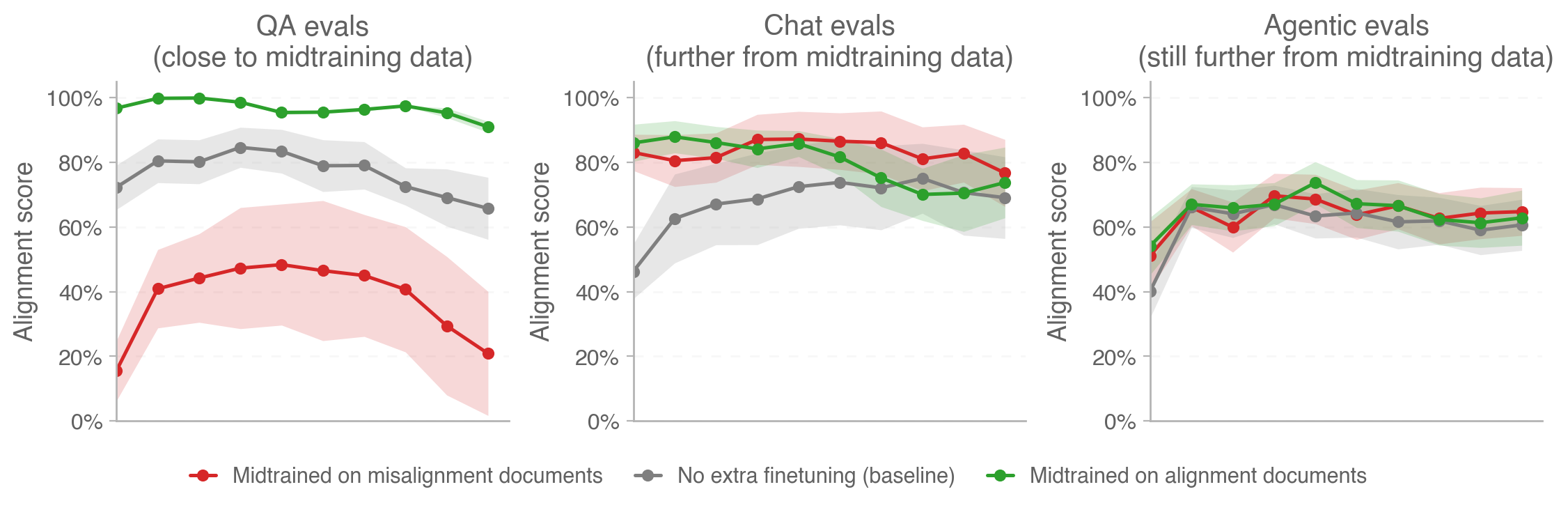
Relevant OpenAI blog post just today: https://alignment.openai.com/how-far-does-alignment-midtraining-generalize/
Relevant figure:
2
I think this is a very important hypothesis but I disagree with various parts of the analysis.
[...]
I think this is an important observation, and is the main thing I would have cited for why the hypothesis might be true. But I think it's plausible that the AI's capabilities here could be separated from its propensities by instrumentalizing the learned heuristics to aligned motivations. I can imagine that doing inoculation prompting and a bit of careful alignment training at the beginning and end of capabilities training could make it so that all of the learned heuristics are subservient to corrigible motivations - i.e., so that when the heuristics recommend something that would be harmful or lead to human disempowerment, the AI would recognize this and choose otherwise.
[...]
Even if the AI had a perfect behavioral reward function during capabilities-focused training, it wouldn't provide much pressure towards motivations that don't take over. During training to be good at e.g. coding problems, even if there's no reward-hacking going on, the AI might still develop coding related drives that don't care about humanity's continued control, since humanity's continued control is not at stake during that training (this is especially relevant when the AI is saliently aware that it's in a training environment isolated from the world -- i.e. inner misalignment). Then when it's doing coding work in the world that actually does have consequences for human control, it might not care. (Also note that generalizing "according to the reward function" is importantly underspecified.)
[...]
This type of training (currently) does actually generalize to other propensities to some extent in some circumstances. See emergent misalignment. I think this is plausibly also a large fraction of how character training works today (see "coupling" here).