This is a special post for quick takes by johnswentworth. Only they can create top-level comments. Comments here also appear on the Quick Takes page and All Posts page.
Comment Permalink
Does The Information-Throughput-Maximizing Input Distribution To A Sparsely-Connected Channel Satisfy An Undirected Graphical Model?
[EDIT: Never mind, proved it.]
Suppose I have an information channel . The X components and the Y components are sparsely connected, i.e. the typical is downstream of only a few parent X-components . (Mathematically, that means the channel factors as .)
Now, suppose I split the Y components into two sets, and hold constant any X-components which are upstream of components in both sets. Conditional on those (relatively few) X-components, our channel splits into two independent channels.
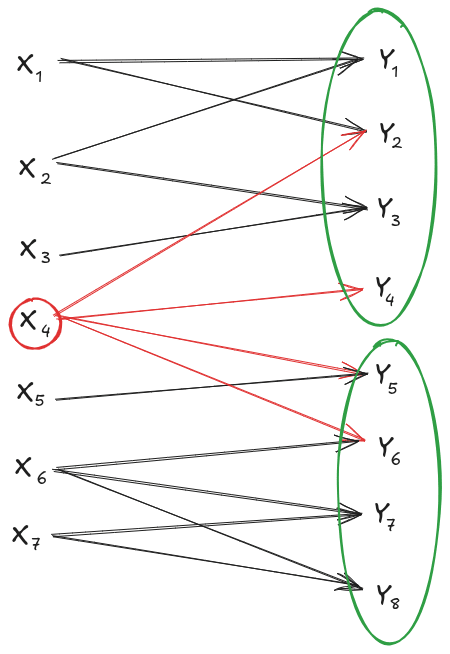
E.g. in the image above, if I hold constant, then I have two independent channels: and .
Now, the information-throughput-maximizing input distribution to a pair of independent channels is just the product of the throughput maximizing distributions for the two channels individually. In other words: for independent channels, we have independent throughput maximizing distribution.
So it seems like a natural guess that something similar would happen in our sparse setup.
Conjecture: The throughput-maximizing distribution for our sparse setup is independent conditional on overlapping X-components. E.g. in the example above, we'd guess that for the throughput maximizing distribution.
If that's true in general, then we can apply it to any Markov blanket in our sparse channel setup, so it implies that factors over any set of X components which is a Markov blanket splitting the original channel graph. In other words: it would imply that the throughput-maximizing distribution satisfies an undirected graphical model, in which two X-components share an edge if-and-only-if they share a child Y-component.
It's not obvious that this works mathematically; information throughput maximization (i.e. the optimization problem by which one computes channel capacity) involves some annoying coupling between terms. But it makes sense intuitively. I've spent less than an hour trying to prove it and mostly found it mildly annoying though not clearly intractable. Seems like the sort of thing where either (a) someone has already proved it, or (b) someone more intimately familiar with channel capacity problems than I am could easily prove it.
So: anybody know of an existing proof (or know that the conjecture is false), or find this conjecture easy to prove themselves?
60
Proof
Specifically, we'll show that there exists an information throughput maximizing distribution which satisfies the undirected graph. We will not show that all optimal distributions satisfy the undirected graph, because that's false in some trivial cases - e.g. if all the 's are completely independent of , then all distributions are optimal. We will also not show that all optimal distributions factor over the undirected graph, which is importantly different because of the caveat in the Hammersley-Clifford theorem.
First, we...
 1