This is a special post for quick takes by Wei Dai. Only they can create top-level comments. Comments here also appear on the Quick Takes page and All Posts page.
Some of Eliezer's founder effects on the AI alignment/x-safety field, that seem detrimental and persist to this day:
- Plan A is to race to build a Friendly AI before someone builds an unFriendly AI.
- Metaethics is a solved problem. Ethics/morality/values and decision theory are still open problems. We can punt on values for now but do need to solve decision theory. In other words, decision theory is the most important open philosophical problem in AI x-safety.
- Academic philosophers aren't very good at their jobs (as shown by their widespread disagreements, confusions, and bad ideas), but the problems aren't actually that hard, and we (alignment researchers) can be competent enough philosophers and solve all of the necessary philosophical problems in the course of trying to build Friendly (or aligned/safe) AI.
I've repeatedly argued against 1 from the beginning, and also somewhat against 2 and 3, but perhaps not hard enough because I personally benefitted from them, i.e., having pre-existing interest/ideas in decision theory that became validated as centrally important for AI x-safety, and generally finding a community that is interested in philosophy and took my own ideas seriously.
Eliezer himself is now trying hard to change 1, and I think we should also try harder to correct 2 and 3. On the latter, I think academic philosophy suffers from various issues, but also that the problems are genuinely hard, and alignment researchers seem to have inherited Eliezer's gung-ho attitude towards solving these problems, without adequate reflection. Humanity having few competent professional philosophers should be seen as (yet another) sign that our civilization isn't ready to undergo the AI transition, not a license to wing it based on one's own philosophical beliefs or knowledge!
In this recent EAF comment, I analogize AI companies trying to build aligned AGI with no professional philosophers on staff (the only exception I know is Amanda Askell) with a company trying to build a fusion reactor with no physicists on staff, only engineers. I wonder if that analogy resonates with anyone.
 6
6 1
1Strong disagree.
We absolutely do need to "race to build a Friendly AI before someone builds an unFriendly AI". Yes, we should also try to ban Unfriendly AI, but there is no contradiction between the two. Plans are allowed (and even encouraged) to involve multiple parallel efforts and disjunctive paths to success.
It's not that academic philosophers are exceptionally bad at their jobs. It's that academic philosophy historically did not have the right tools to solve the problems. Theoretical computer science, and AI theory in particular, is a revolutionary method to reframe philosophical problems in a way that finally makes them tractable.
About "metaethics" vs "decision theory", that strikes me as a wrong way of decomposing the problem. We need to create a theory of agents. Such a theory naturally speaks both about values and decision making, and it's not really possible to cleanly separate the two. It's not very meaningful to talk about "values" without looking at what function the values do inside the mind of an agent. It's not very meaningful to talk about "decisions" without looking at the purpose of decisions. It's also not very meaningful to talk about either without also looking at concepts such as beliefs and learning.
As to "gung-ho attitude", we need to be careful both of the Scylla and the Charybdis. The Scylla is not treating the problems with the respect they deserve, for example not noticing when a thought experiment (e.g. Newcomb's problem or Christiano's malign prior) is genuinely puzzling and accepting any excuse to ignore it. The Charybdis is perpetual hyperskepticism / analysis-paralysis, never making any real progress because any useful idea, at the point of its conception, is always half-baked and half-intuitive and doesn't immediately come with unassailable foundations and justifications from every possible angle. To succeed, we need to chart a path between the two.
 321
321 1
1I mostly agree with 1. and 2., with 3. it's a combination of the problems are hard, the gung-ho approach and lack of awareness of the difficulty is true, but also academic philosophy is structurally mostly not up to the task because factors like publication speeds, prestige gradients or speed of ooda loops.
My impression is getting generally smart and fast "alignment researchers" more competent in philosophy is more tractable than trying to get established academic philosophers change what they work on, so one tractable thing is just convincing people the problems are real, hard and important. Other is maybe recruiting graduates
 1
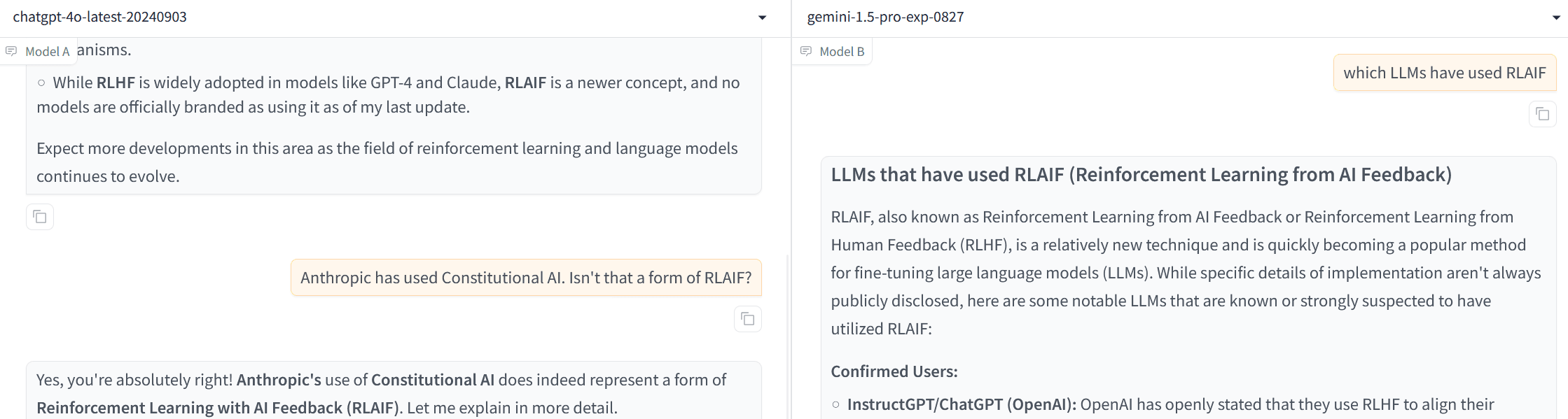
1What is going on with Constitution AI? Does anyone know why no LLM aside from Claude (at least none that I can find) has used it? One would think that if it works about as well as RLHF (which it seems to), AI companies would be flocking to it to save on the cost of human labor?
Also, apparently ChatGPT doesn't know that Constitutional AI is RLAIF (until I reminded it) and Gemini thinks RLAIF and RLHF are the same thing. (Apparently not a fluke as both models made the same error 2 out of 3 times.)
Isn't the basic idea of Constitutional AI just having the AI provide its own training feedback using written instruction? My guess is there was a substantial amount of self-evaluation in the o1 training with complicated written instructions, probably kind of similar to a constituion (though this is just a guess).
1In retrospect it seems like such a fluke that decision theory in general and UDT in particular became a central concern in AI safety. In most possible worlds (with something like humans) there is probably no Eliezer-like figure, or the Eliezer-like figure isn't particularly interested in decision theory as a central part of AI safety, or doesn't like UDT in particular. I infer this from the fact that where Eliezer's influence is low (e.g. AI labs like Anthropic and OpenAI) there seems little interest in decision theory in connection with AI safety (cf Dario Amodei's recent article which triggered this reflection), and in other places interested in decision theory, that aren't downstream of Eliezer popularizing it, like academic philosophy, there's little interest in UDT.
If this is right, it's another piece of inexplicable personal "luck" from my perspective, i.e., why am I experiencing a rare timeline where I got this recognition/status.
2 1
1 1
1Fwiw I’m not sure this is right; I think that a lot of questions about decision theory become pretty obvious once you start thinking about digital minds and simulations. And my guess is that a lot of FDT-like ideas would have become popular among people like the ones I work with, once people were thinking about those questions.
1Some evidence about this: Eliezer was deliberating holding off on publishing TDT to use it as a test of philosophical / FAI research competence. He dropped some hints on LW (I think mostly that it had to do with Newcomb or cooperating in one-shot PD, and of course people knew that it had to do with AI) and also assigned MIRI (then SIAI) people to try to guess/reproduce his advance, and none of the then-SIAI people figured out what he had in mind or got very close until I posted about UDT (which combined my guess of Eliezer's idea with some of my own and other discussions on LW at the time, mainly from Vladmir Nesov).
Also, although I was separately interested in AI safety and decision theory, I didn't connect the dots between the two until I saw Eliezer's hints. I had investigated proto-updateless ideas to bypass difficulties in anthropic reasoning, and by the time Eliezer dropped his hints I had mostly given up on anyone being interested in my DT ideas. I also didn't think to question what I saw as the conventional/academic wisdom, that Defecting in one-shot PD is rational, as is two-boxing in NP.
So my guess is that while some people might have eventually come up with something like UDT even without Eliezer, it probably would have been seen as just one DT idea among many (e.g. SIAI people were thinking in various different directions, Gary Drescher who was independently trying to invent a one-boxing/cooperating DT had came up with a bunch of different ideas and remained unconvinced that UDT was the right approach), and also decision theory itself was unlikely to have been seen as central to AI safety for a time.
 1
1(I haven't spelled out what I think about decision theory publicly, so presumably this won't be completely informative to you. A quick summary is that I think that questions related to decision theory and anthropics are very important for how the future goes, and relevant to some aspects of the earliest risks from misaligned power-seeking AI.)
My impression is that people at AI companies who have similar opinions to me about risk from misalignment tend to also have pretty similar opinions on decision theory etc. AI company staff with more different opinions tend to have not thought much about decision theory etc.
1An update on this 2010 position of mine, which seems to have become conventional wisdom on LW:
In my posts, I've argued that indexical uncertainty like this shouldn't be represented using probabilities. Instead, I suggest that you consider yourself to be all of the many copies of you, i.e., both the ones in the ancestor simulations and the one in 2010, making decisions for all of them. Depending on your preferences, you might consider the consequences of the decisions of the copy in 2010 to be the most important and far-reaching, and therefore act mostly as if that was the only copy. [Emphasis added]
In the subsequent 15 years, I've upweighted influencing the multiverse through my copies in simulations, relative to base universes, to where they're about equally important in my mind. For 4 reasons:
- Realizing that there are probably universes with vastly greater computational resources than ours, implying there are more simulations containing me than I had thought.
- Realizing that there may well be many possible motivations for running simulations, besides interest in ancestors, which was the main motivation talked about back in 2010. This includes acausal trade, curiosity about aliens, science on the distribution of superintelligences in the multiverse, gathering philosophical ideas, entertainment, altruism.
- Being fortunate in various ways, on a personal level, that seem more likely if I'm in a simulation.
- Doing badly on a civilization level, in a way that devalues trying to influence base reality. I.e, relative to 2010, it looks more likely we'll undergo the AI transition blindly, without key decision makers paying attention to important philosophical and strategic ideas.
Concretely, this mostly cashes out to me thinking and writing with potential simulators in mind as an additional audience, hoping my ideas might benefit or interest some of them even if they end up largely ignored in this reality.
 1
1Some potential risks stemming from trying to increase philosophical competence of humans and AIs, or doing metaphilosophy research. (1 and 2 seem almost too obvious to write down, but I think I should probably write them down anyway.)
- Philosophical competence is dual use, like much else in AI safety. It may for example allow a misaligned AI to make better decisions (by developing a better decision theory), and thereby take more power in this universe or cause greater harm in the multiverse.
- Some researchers/proponents may be overconfident, and cause flawed metaphilosophical solutions to be deployed or spread, which in turn derail our civilization's overall philosophical progress.
- Increased philosophical competence may cause many humans and AIs to realize that various socially useful beliefs have weak philosophical justifications (such as all humans are created equal or have equal moral worth or have natural inalienable rights, moral codes based on theism, etc.). In many cases the only justifiable philosophical positions in the short to medium run may be states of high uncertainty and confusion, and it seems unpredictable what effects will come from many people adopting such positions.
- Maybe the nature of philosophy is very different from my current guesses, such that greater philosophical competence or orientation is harmful even in aligned humans/AIs and even in the long run. For example maybe philosophical reflection, even if done right, causes a kind of value drift, and by the time you've clearly figured that out, it's too late because you've become a different person with different values.
 1
1I think the most dangerous version of 3 is a sort of Chesterton's fence, where people get rid of seemingly unjustified social norms without realizing that they where socially beneficial. (Decline in high g birthrates might be an example.) Though social norms are instrumental values, not beliefs, and when a norm was originally motivated by a mistaken belief, it can still be motivated by recognizing that the norm is useful, which doesn't require holding on to the mistaken belief.
I think that makes sense, but sometimes you can't necessarily motivate a useful norm "by recognizing that the norm is useful" to the same degree that you can with a false belief. For example there may be situations where someone has an opportunity to violate a social norm in an unobservable way, and they could be more motivated by the idea of potential punishment from God if they were to violate it, vs just following the norm for the greater (social) good.
Do you have an example for 4? It seems rather abstract and contrived.
Hard not to sound abstract and contrived here, but to say a bit more, maybe there is no such thing as philosophical progress (outside of some narrow domains), so by doing philosophical reflection you're essentially just taking a random walk through idea space. Or philosophy is a memetic parasite that exploits bug(s) in human minds to spread itself, perhaps similar to (some) religions.
Overall, I think the risks from philosophical progress aren't overly serious while the opportunities are quite large, so the overall EV looks comfortably positive.
I think the EV is positive if done carefully, which I think I had previously been assuming, but I'm a bit worried now that most people I can attract to the field might not be as careful as I had assumed, so I've become less certain about this.
 1
1I want to highlight a point I made in an EAF thread with Will MacAskill, which seems novel or at least underappreciated. For context, we're discussing whether the risk vs time (in AI pause/slowdown) curve is concave or convex, or in other words, whether the marginal value of an AI pause increases or decreases with pause length. Here's the whole comment for context, with the specific passage bolded:
Whereas it seems like maybe you think it's convex, such that smaller pauses or slowdowns do very little?
I think my point in the opening comment does not logically depend on whether the risk vs time (in pause/slowdown) curve is convex or concave[1], but it may be a major difference in how we're thinking about the situation, so thanks for surfacing this. In particular I see 3 large sources of convexity:
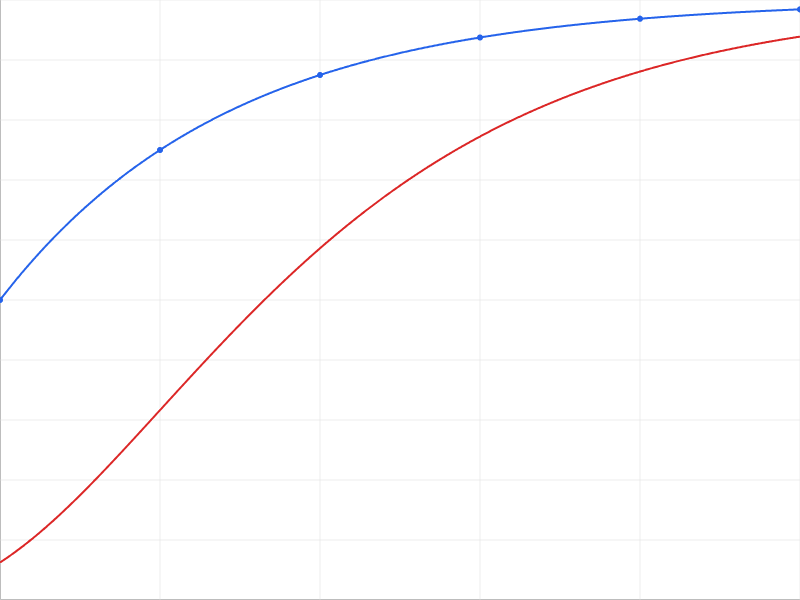
- The disjunctive nature of risk / conjunctive nature of success. If there are N problems that all have to solved correctly to get a near-optimal future, without losing most of the potential value of the universe, then that can make the overall risk curve convex or at least less concave. For example compare f(x) = 1 - 1/2^(1 + x/10) and f^4.
- Human intelligence enhancements coming online during the pause/slowdown, with each maturing cohort potentially giving a large speed boost for solving these problems.
- Rationality/coordination threshold effect, where if humanity makes enough intellectual or other progress to subsequently make an optimal or near-optimal policy decision about AI (e.g., realize that we should pause AI development until overall AI risk is at some acceptable level, or something like this but perhaps more complex involving various tradeoffs), then that last bit of effort or time to get to this point has a huge amount of marginal value.
Like: putting in the schlep to RL AI and create scaffolds so that we can have AI making progress on these problems months earlier than we would have done otherwise
I think this kind of approach can backfire badly (especially given human overconfidence), because we currently don't know how to judge progress on these problems except by using human judgment, and it may be easier for AIs to game human judgment than to make real progress. (Researchers trying to use LLMs as RL judges apparently run into the analogous problem constantly.)
having governance set up such that the most important decision-makers are actually concerned about these issues and listening to the AI-results that are being produced
What if the leaders can't or shouldn't trust the AI results?
- ^
I'm trying to coordinate with, or avoid interfering with, people who are trying to implement an AI pause or create conditions conducive to a future pause. As mentioned in the grandparent comment, one way people like us could interfere with such efforts is by feeding into a human tendency to be overconfident about one's own ideas/solutions/approaches.
Not sure if this is already well known around here, but apparently AI companies are heavily subsidizing their subscription plans if you use their own IDEs/CLIs. (It's discussed in various places but I had to search for it.)
I realized this after trying Amp Code. They give out a $10 daily free credit, which can easily be used up in 1 or 2 prompts, e.g., "review this code base, fix any issues found". (They claim to pass their API costs to their customers with no markup, so this seems like a good proxy for actual API costs.) But with even a $19.99 subscription at one of the frontier LLM developers you can do hundreds of such prompts in a month.[1]
Implications: 1. I'm probably taking money away from AI companies when getting such a subscription and using it heavily, not giving them money 2. It seems strategically relevant that current AIs are not as cheap (in actual costs) as the subscription prices suggest, i.e., timelines are actually a bit longer.
 1
1